 AirHorizon
AirHorizon: Attitude Indicator
Flight HUD for iPhone & iPad
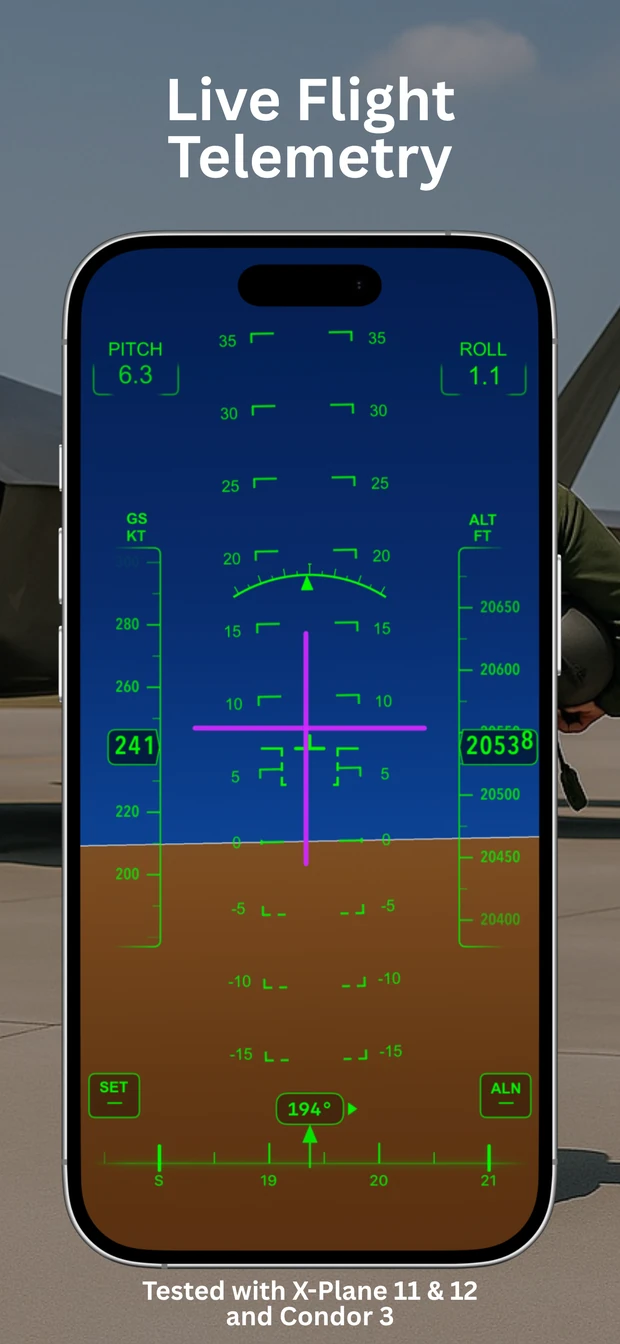
AirHorizon turns your iPhone or iPad into a real-time artificial horizon: pitch, roll, heading tape, ground speed and altitude in one clear head-up display. Run it on the device's own sensors, or bring in live flight telemetry from X-Plane 11, X-Plane 12 or Condor 3 over your local network.
See and hear climb and descent with the visual and audio variometer, available with AirHorizon Pro.

Everything on one screen
A HUD-style layout built to be readable at a glance — in daylight, at night, and in motion.
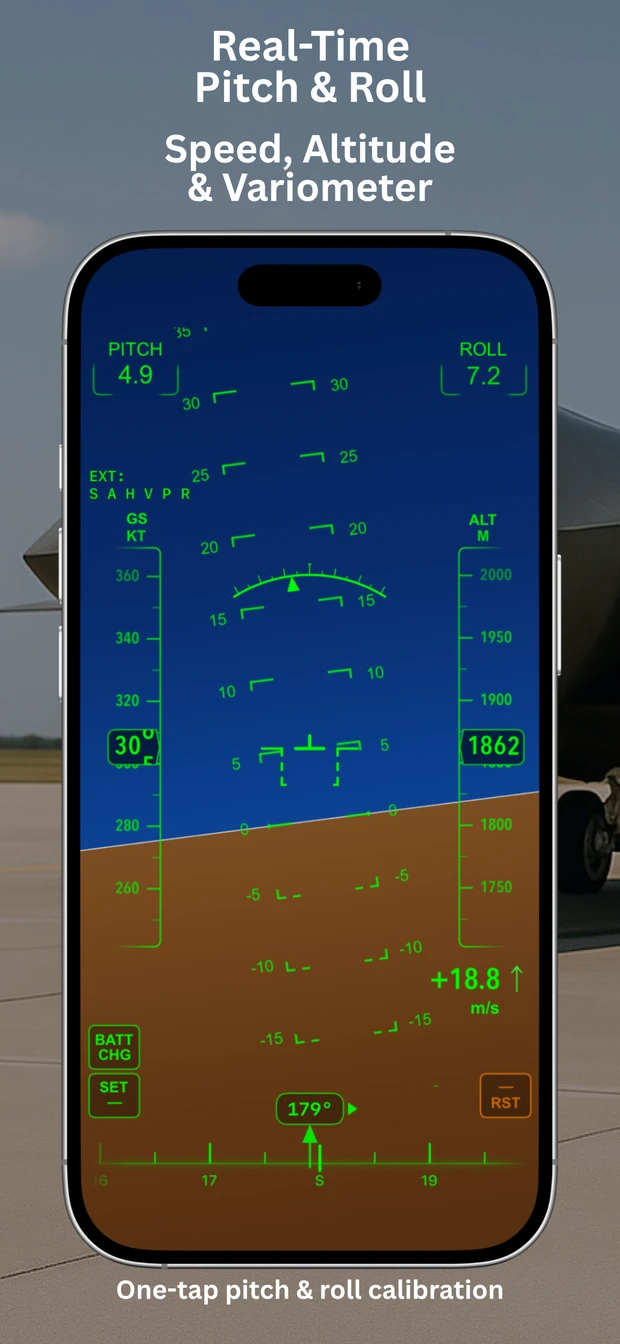
Real-time pitch & roll
A live artificial horizon driven by the device motion sensors, with one-tap pitch and roll calibration for however your device is mounted.
Speed & altitude tapes
Ground speed in knots and altitude in feet on classic vertical tapes, from the device's location and barometric sensors, or from your simulator.
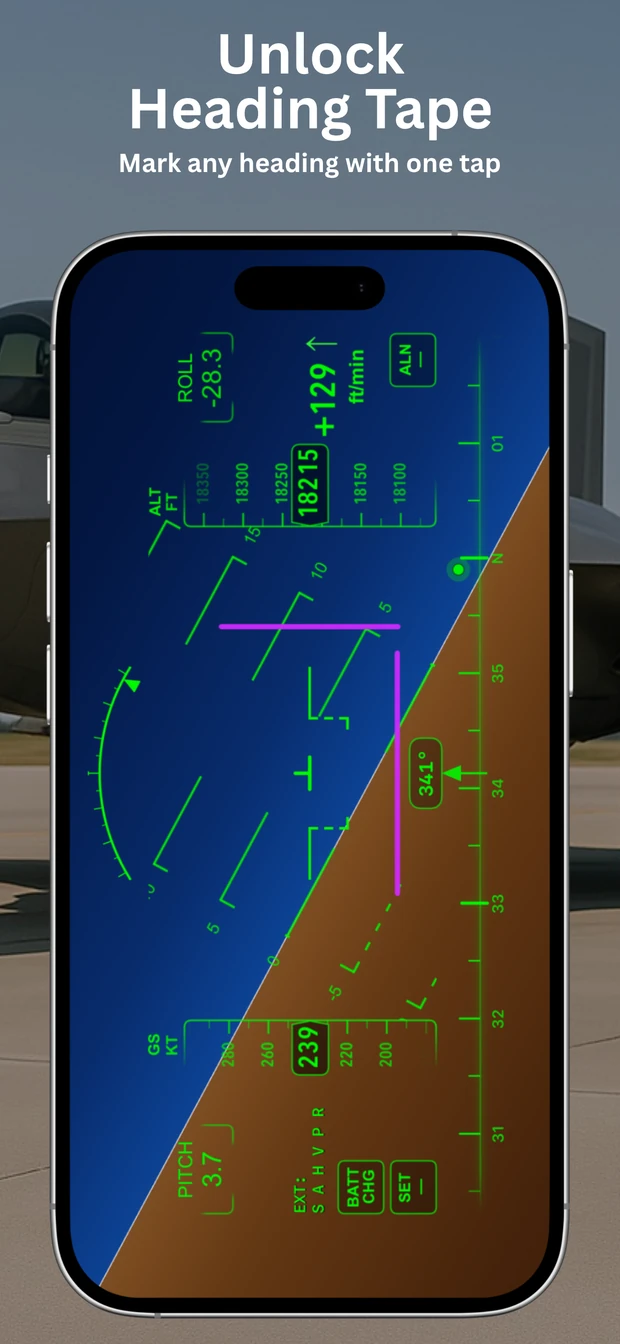
Heading tape with markers
Mark any heading with a single tap and hold your reference. Off-screen cue arrows point back to a marker that has drifted out of view.
Director mode
Guidance bars driven by X-Plane's flight-director commands. Director Mode requires the matching X-Plane data output; it is not available from Condor 3.
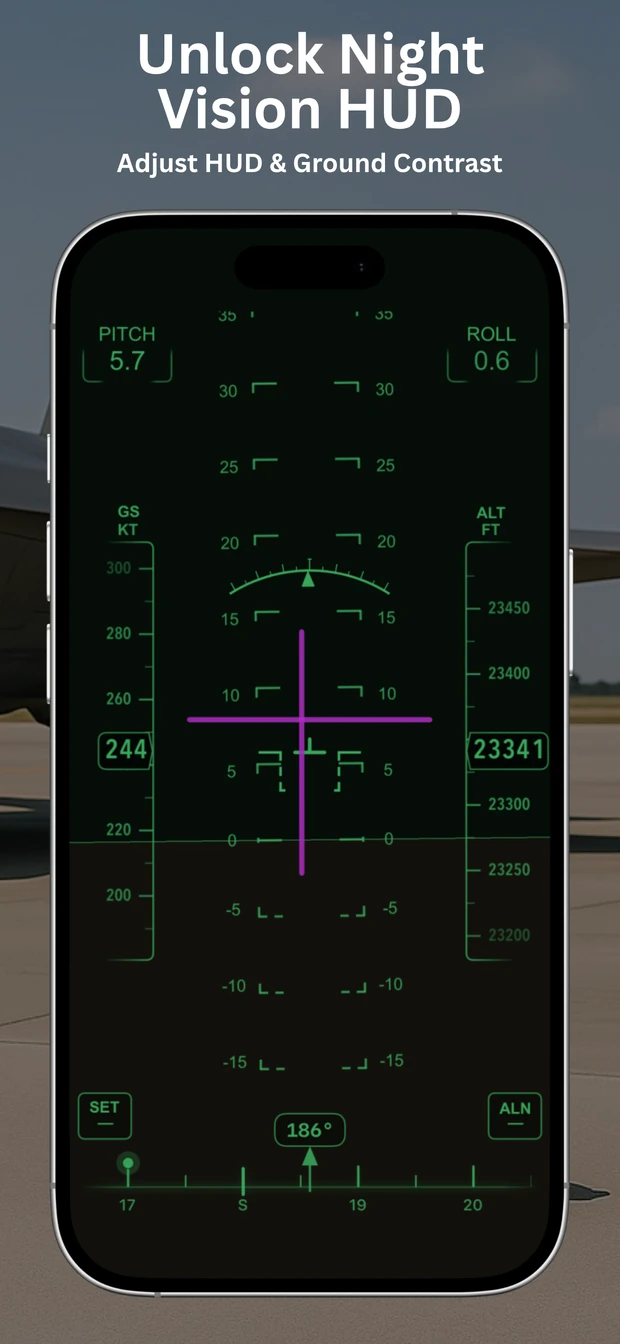
Night vision HUD
A low-emission night palette with adjustable HUD and ground contrast, so the display stays readable without wrecking your dark adaptation.
Visual & audio variometer
See vertical speed and hear optional climb and descent cues. Use device sensors or external readings from X-Plane or Condor 3. Explore the variometer.
Climb and descent, seen and heard
Follow vertical speed on the HUD, with optional audio cues for climb and descent. Choose your source, units, sensitivity and response in Settings › Variometer.
Device sensors
Combine device motion with barometric or GPS altitude. Auto uses the barometer when available and falls back to GPS when pressure data is unavailable.
External flight data
Receive variometer readings from X-Plane 11, X-Plane 12 or Condor 3 over your local network. See the connection guide.
Optional sound
Enable sound to hear climb and descent cues. With sound enabled, the variometer can continue with the screen locked or while another app is open, subject to permissions and system limits.
See it in the cockpit
Swipe through the display modes.
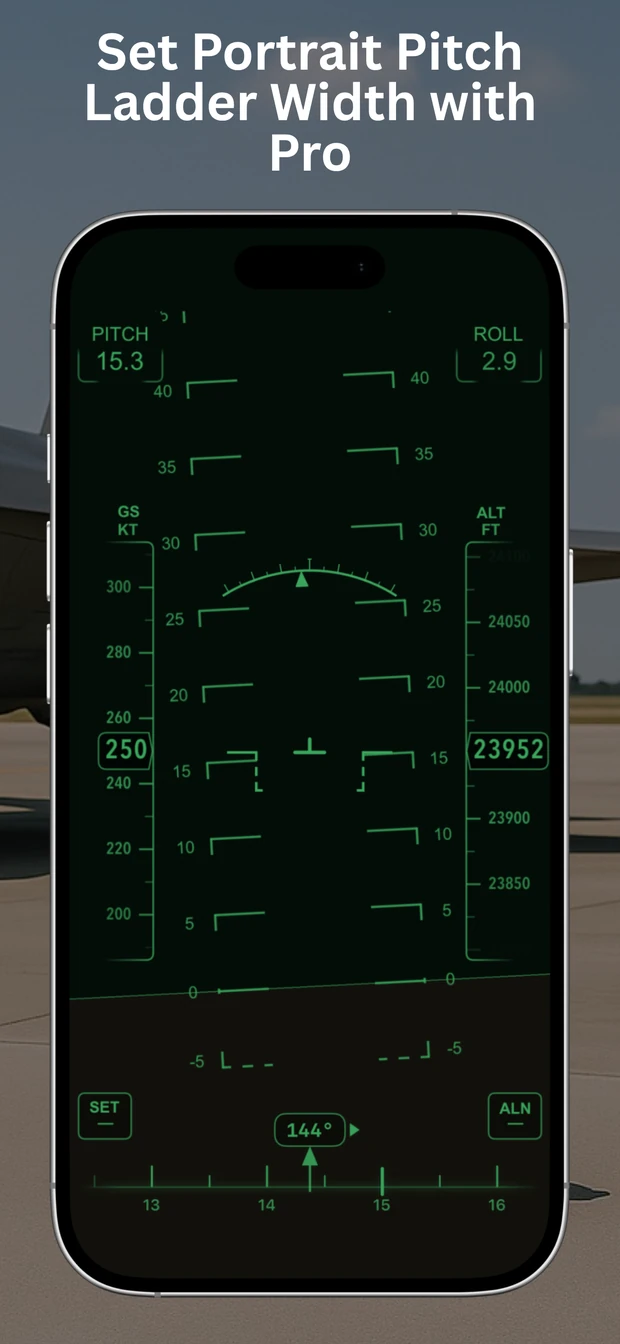
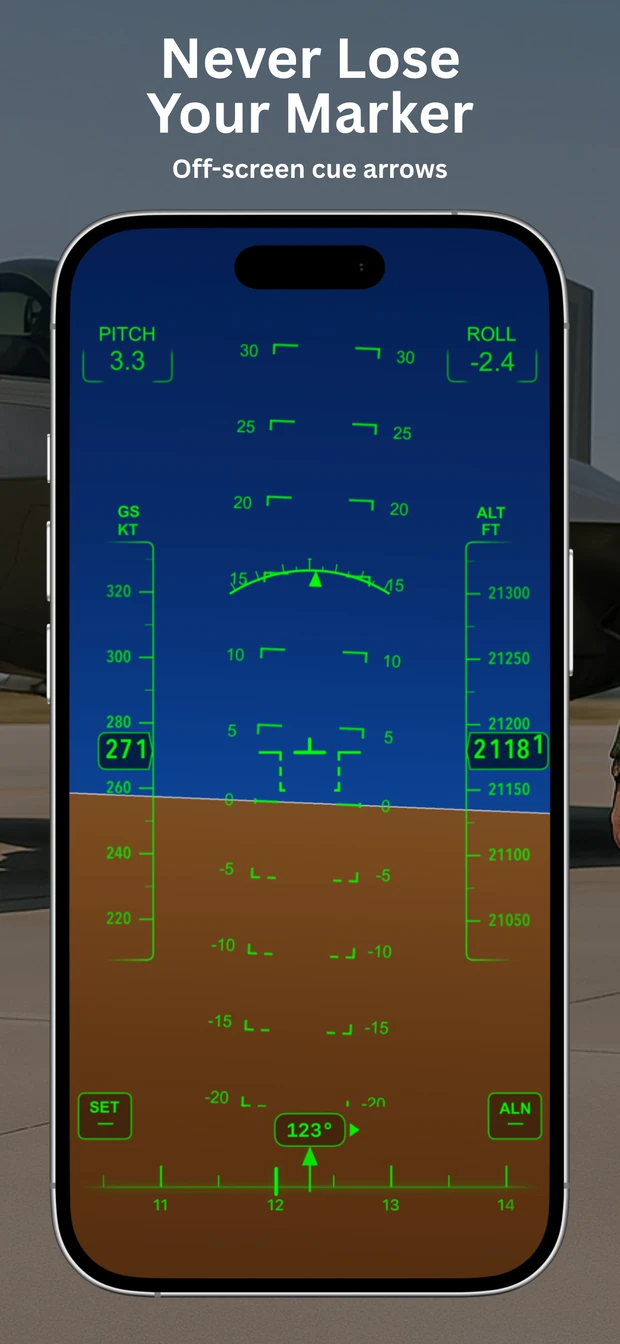
The same instrument, on a bigger panel
AirHorizon is a universal app — one free download that runs natively on iPhone and iPad, with no separate version to buy. On an iPad the horizon, the pitch ladder and the speed and altitude tapes get room to breathe, which makes the display readable from further away: useful when the tablet sits on a desk next to your simulator rig rather than in your hand.


X-Plane 11 and X-Plane 12 telemetry have been tested on both iPhone and iPad. The connection steps are the same: use the IP address of the device receiving the data.
Connect X-Plane or Condor 3
Bring live flight data to the same HUD. Choose which readings come from an external source,
including the variometer. Both simulator setups send data to AirHorizon over your local network
on UDP port 49000.
Join the same network
Connect your iPhone or iPad and the simulator computer to the same local network. Find the device IP in Settings › Wi-Fi › current network info › IP Address.
Set up your simulator
Follow the X-Plane or Condor 3 guide below.
Enter your device IP as the destination and use port 49000. Start a flight to send live readings.
Choose external readings
Allow Local Network access. In AirHorizon Settings › External Source, choose the signals to receive, or enable Use External for All. For the variometer, also turn on Show Variometer.
X-Plane 11 & X-Plane 12
No X-Plane plugin is needed. Open the network / data output settings, enable UDP output,
enter your device IP, and set the destination port to 49000.
In Settings › Data Output, enable Network via UDP for the rows you need. Show in Cockpit alone does not send data to AirHorizon.
| Row | Group | Used for |
|---|---|---|
3 | Speeds | Ground speed in knots |
4 | Mach, VVI, G-load | Vertical speed for the variometer |
17 | Pitch, roll, headings | Pitch, roll and heading in degrees |
20 | Latitude, longitude, altitude | Altitude MSL in feet |
108 | Autopilot, flight director, HUD | Flight-director mode, pitch and roll for Director Mode |
Row 4 is required for the variometer even when the other tapes already work.
Enable Director Mode only when flight-director data is being sent. Some X-Plane versions expose
similar flight-director data under a nearby row number.
Condor 3
Close Condor 3, then open Settings/UDP.ini inside the Condor installation folder.
Use the settings below, replacing <device IP address> with your iPhone or iPad's IP:
[General]
Enabled=1

[Connection]
Host=<device IP address>
Port=49000

[Misc]
SendIntervalMs=50
ExtendedData=0
ExtendedData1=0
LogToFile=0
Save the file, restart Condor 3, and start a flight. This uses Generic UDP output;
NMEA output is a separate feature. Keep ExtendedData and ExtendedData1 set to 0.
The HUD receives pitch, bank, compass heading, altitude, ground speed and variometer data. The speed tape shows horizontal ground speed, which can differ from Condor's airspeed indicator. AirHorizon converts Condor's pitch and bank from radians and altitude from meters.
Leave Director Mode off: Condor does not supply X-Plane flight-director commands.
Tested setup: X-Plane 11 and X-Plane 12 with AirHorizon on iOS and iPadOS; Condor 3 with AirHorizon on iOS. All simulators ran on macOS; Condor 3 ran through CrossOver.
Other sources may work if they send a flight-data message format supported by AirHorizon. Using UDP alone does not guarantee compatibility.
Connection status: EXT lists channels with fresh data:
S speed, A altitude, H heading, V variometer, P pitch, R roll.
Missing letters mean those channels are waiting; WAIT means all selected channels are waiting.
During delays, pitch, roll, heading, speed and altitude hold their last readings.
Select the device source explicitly to return to device sensors.
AirHorizon in action
Short clips from the simulator and from the real world.
X-Plane 12 — altitude, speed and Director Mode live
Helicopter over Rio de Janeiro, past Christ the Redeemer
Airliner passenger seat — watching altitude and speed build
Back seat of a car — how the sensors behave on the move
No simulator? It still works
With no external source connected, AirHorizon runs entirely on your device: the motion sensors drive pitch and roll, location services provide ground speed and a true-north heading reference, and the barometric sensor handles altitude. That is the same display, whether you are at a desk, in a car, or in a passenger seat at 30,000 feet.
On-device processing
Sensor data is processed on your device. There is no account to create and no telemetry to sign up for.
Portrait or landscape
Designed for the way people actually mount a phone — with calibration to zero out the mounting angle.
iPhone and iPad
One universal app, one free download, laid out natively for both screens — see it on iPad.
Important: not a certified instrument
AirHorizon is a consumer application for flight simulation, training reference, and general interest. It is not a certified aviation instrument, it is not approved for navigation or for operating an aircraft, and it must not be used as a primary or backup attitude reference in a real aircraft.
Consumer device sensors are affected by acceleration, vibration, temperature, magnetic interference and signal loss. Always fly by your aircraft's certified instruments and follow the applicable regulations. How you choose to use the app is your own responsibility.
Frequently asked questions
Which simulators have been tested?
External telemetry was tested on iOS and iPadOS with X-Plane 11 and X-Plane 12, and on iOS with Condor 3. All simulators ran on macOS; Condor 3 ran through CrossOver.
Do I need to install a simulator plugin?
No simulator plugin is required for these setups. Use the built-in UDP data output in X-Plane or the Generic UDP output configured in Condor 3’s Settings/UDP.ini.
Which port and X-Plane data rows does it use?
UDP port 49000 for both simulators. In X-Plane, enable Network via UDP for rows 3 (speeds), 4 (variometer), 17 (pitch, roll, headings), 20 (altitude) and 108 (Director Mode). Condor uses the UDP.ini settings above instead of data rows.
Does Director Mode work with Condor 3?
No. Director Mode uses X-Plane flight-director commands, which Condor 3 does not provide. Leave Director Mode off when using Condor.
Why is the variometer not showing external data?
Turn on Show Variometer and Use External for Variometer. In X-Plane, enable Network via UDP for row 4 (Mach, VVI, G-load). In Condor 3, make sure Generic UDP output is enabled and a flight is running without pause.
Can I connect another external telemetry source?
Other sources may work if they transmit flight data in a message format supported by AirHorizon. Sending UDP packets or matching the parameter names alone does not establish compatibility.
Can I use it without a flight simulator?
Yes. Without an external source AirHorizon runs on the device's own motion, location and barometric sensors, and shows pitch, roll, heading, ground speed and altitude on its own.
Can I use it in a real aircraft?
AirHorizon is not a certified aviation instrument and is not approved for navigation or flight operations. Treat it as a simulation and reference tool only, and fly by your certified instruments.
How much does it cost?
The app is free to download from the App Store. Some display options are part of the optional Pro upgrade.
Data does not appear after setup. What should I check?
Check the device IP, port 49000, Local Network permission and that both devices are on the same local network. In X-Plane, tick Network via UDP for each required row. In Condor, check Enabled=1 in UDP.ini and start a flight. VPNs, guest Wi-Fi and router client isolation can block local UDP traffic.
Still stuck, or want to suggest a feature? Send a message through the support form — it goes straight to the developer.
Put a horizon in your pocket
Free on the App Store for iPhone and iPad, iOS 18.1 or later.
Download on the App Store